Report 04/2026: Derailment at Denbigh Hall South Junction
RAIB has today released its report into a derailment at Denbigh Hall South Junction, near Bletchley, Buckinghamshire, 26 June 2025.
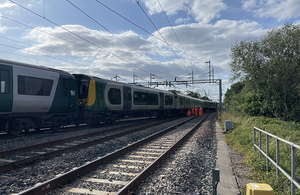
The derailed train at Denbigh Hall South Junction.
Summary
At about 12:27 on 26 June 2025, an out-of-service passenger train travelling at 15 mph (24 km/h) derailed as it passed over Denbigh Hall South Junction, on the West Coast Main Line, between Bletchley and Milton Keynes Central stations. At the time of the derailment, soon after the start of its journey from Bletchley station to a depot at Northampton, the train was making a wrong-direction movement over the junction. There were no injuries to any of the four members of train crew on the train but damage was caused to the train and to railway infrastructure.
The train derailed on switch diamond points which were in an unsafe position for the direction that the train was travelling over them. It had been necessary for the train to make a wrong-direction movement due to a fault which had prevented the driver from moving the train from the cab at one end. Once the need for the wrong-direction movement was identified and agreed, signalling staff at Rugby Signalling Control Centre proposed and then implemented a path for the train which they did not realise was invalid. Subsequent checking activities by these signalling staff did not identify this. When the train then arrived at the junction, no one in the train’s leading cab noticed that the switch diamond points were in an unsafe position for the train to pass over them.
A probable underlying factor to the accident was the staff involved had variable knowledge and understanding of what switch diamond points were and how trains operated over them. A possible underlying factor was that the training for signallers, when applying the Rule Book modules for authorising a train to pass a signal at danger (red) and for wrong-direction movements, did not sufficiently account for the information, strategies and knowledge used by experienced signallers.
As part of its investigation, RAIB also observed that the Rule Book did not cover the specific circumstances of this wrong-direction movement. This meant that the signaller was unintentionally not following the rules when they had authorised the driver to pass a signal at danger at the start of the movement.
Recommendations
RAIB has made four recommendations as a result of this investigation. The first is addressed to Network Rail to provide training to signallers on the tools and techniques that can be used when setting up and checking the proposed path for a train to take during an out‑of‑course event. The second and third, addressed to Network Rail and West Midlands Trains respectively, are to develop training for staff to give them the appropriate level of knowledge and understanding of switch diamond points to allow them to undertake their duties in accordance with the Rule Book. The fourth is addressed to the Rail Safety and Standards Board, in consultation with the rail industry, to consider whether the Rule Book needs to account for the scenario where a signal at danger is located at, or near to, the start of a planned wrong‑direction movement.
RAIB also identified four learning points. They cover staff understanding the impact that personal issues can have on themselves; the importance of staff taking the time to stop and check again, or continuing to challenge if unsure; reminding signallers that they should ask a competent person, if present, to check the path that they have set up for the wrong-direction movement; and reminding drivers that during a wrong‑direction movement, they can approach a junction at a speed slower than 15 mph (or 25 km/h) to give themselves more time to make sure, if possible, that any points, switch diamonds or swing-nose crossings are in the correct position.
Notes to editors
-
The sole purpose of RAIB investigations is to prevent future accidents and incidents and improve railway safety. RAIB does not establish blame, liability or carry out prosecutions.
-
RAIB operates, as far as possible, in an open and transparent manner. While our investigations are completely independent of the railway industry, we do maintain close liaison with railway companies and if we discover matters that may affect the safety of the railway, we make sure that information about them is circulated to the right people as soon as possible, and certainly long before publication of our final report.
-
For media enquiries, please call 01932 440015.